Scroll up
Skip to main content

1970s

Artist

Further Details
Collection
Private Collection

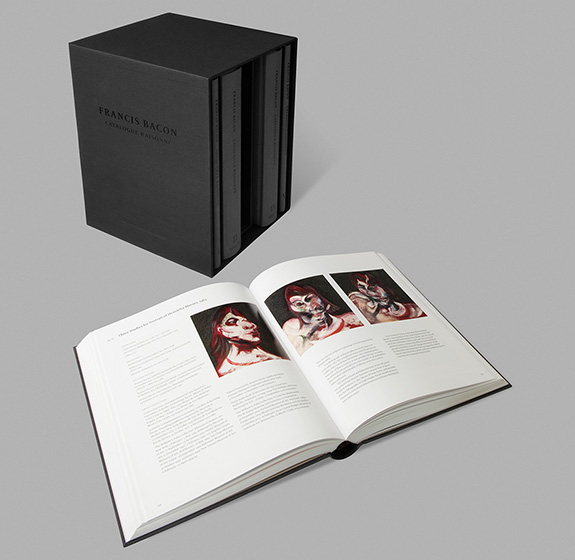
The information in the present section on francis-bacon.com is based on the data in Francis Bacon: Catalogue Raisonné by Martin Harrison and Rebecca Daniels, which was published by The Estate of Francis Bacon in 2016. The following ‘Notes for readers’ are extracted from the catalogue raisonné (Vol.1, p.102 and 103) and elaborate on the methodology and thinking behind the compilation and presentation of some data, such as titles, dates and media.


Notes for readers

Paintings are catalogued chronologically, under the year of their completion: thus a painting dated 1956-57 will be found in 1957. Undocumented paintings, to which only approximate (circa) dates can be attached, are generally placed at the end of the year in which they are believed to have been painted; this rule is departed from when there is firm evidence that a painting was made at a specific date during a certain year (for example ‘Street Scene (with Car in Distance)’, 1984 (84-03).

Titles of paintings placed in inverted commas, for example ‘Figure with Cricket Pad’, c.1982 (82-09), were not applied by Bacon or by his gallerists, and are merely descriptive. Among the paintings with descriptive titles in the catalogue, many did not emerge into public view until after 1998. Some of the titles initially given to them have been revised here; for example, ‘Figures in a Landscape’, c.1956 (56-11) has been substituted for ‘Two Figures in the Grass’, which is more logical in view of its relationship with Figures in a Landscape, 1956-57 (57-01).


Media

In the past most of Bacon’s paintings have been described as ‘oil on canvas’. But he employed many other media, and was fond of mixing sand, dust, fibres and pastel, for example, with his oils. While every effort has been made to include these details, until paintings are examined (and ideally scientifically tested) with the glass removed, the descriptions of media will inevitably be incomplete.


Dimensions

Canvas dimensions are given in imperial measurements, height preceding width, followed by metric; this conforms with the British manufacture of Bacon’s canvasses.


Signatures

After 1969, Bacon titled, signed and dated, on the reverse of the canvas, a majority of his paintings: before that date he only did so intermittently. It has been our aim to record all such details, but there are almost certainly omissions. The modern practice of fixing backing boards on paintings means that, even when granted privileged access to works, it is not always possible to inspect the reverse side.


Photography dates

Paintings were usually sent to be photographed shortly after leaving Bacon’s studio. The photography dates provide key data, therefore, in the chronology of paintings.


Alley

Alley numbers, for example (Alley 106), are those assigned to each painting in the first catalogue raisonné, Ronald Alley and John Rothenstein, Francis Bacon (London: Thames & Hudson; New York: Viking Press, 1964).


Destroyed paintings

Bacon destroyed many hundreds of paintings. The so-called ‘slashed canvasses’ are not (with one exception, Double Portrait of Lucian Freud and Frank Auerbach, 1964 (64-03)) included in this catalogue. Forty such canvasses, found in Bacon’s studio after he died, are now in Dublin City Gallery The Hugh Lane. Margarita Cappock published them in 2005 under the heading ‘Destroyed Canvasses’, which raised questions regarding Bacon’s intentions with the destructions. On small portrait canvasses he – or a friend – invariably cut out the head, and on the large canvasses the heads and sufficient of the main figurative elements to nullify the ‘image’ were excised. Doubtless Bacon cut the canvasses so as to leave the stretchers intact for reusage, but while he could not have foreseen the tattered fragments eventually having a commercial value, or being exhibited, he could have rendered the destruction more complete (by burning the fragments, for example). His partial destructions were, typically, ambivalent, while as the creator of images that had ‘failed’, the connotations of violence in his taking a knife to them has clear psychological implications.

Four canvasses removed from Bacon’s studio in 1978 appeared on the market in April 2007, and a further five, from a separate source, were sold in June 2007; six fragments of canvas which had been given in the 1950s to the Cambridge artist Lewis Todd, who painted on their primed sides, were auctioned in March 2013.

Paintings with the suffix ‘D’ in the catalogue (for example 67-15D) are destroyed. Two of these are paintings which had been sold and were destroyed in accidents while in private ownership; a third was damaged beyond restoration when it fell into Tokyo Dock. Other paintings with this suffix in the present catalogue were destroyed by Bacon but had been exhibited publicly before he did so; since images of them are accessible in catalogues, they have been included for the sake of completeness.

In the 1964 catalogue raisonné, under pressure from Bacon, Ronald Alley consigned abandoned or destroyed paintings to two appendixes, classified as ‘A’ and ‘D’. These compromise categories have been jettisoned in the present catalogue, and the extant paintings placed where they occur in the chronology. A compelling reason for ceasing to adopt these categories is that of the nine paintings Alley listed as ‘Destroyed’ in 1964, four in fact survive.

Abandoned paintings

On 30 July 1996 David Sylvester wrote to the then owner of ‘Lying Figure’, c.1953 (53-21), who was disappointed he had not included it in the Bacon retrospective at the Centre Pompidou, Paris. He explained that none of the pictures listed in the 1964 catalogue raisonné as ‘Abandoned’ was treated as a candidate for inclusion, adding ‘it seems reasonable to me that during an artist’s lifetime and for a few years after his death, a retrospective exhibition should not include works that he considered abandoned. I think that a different attitude should be taken when an artist has been dead for some years.’ Sylvester volunteered the comment: ‘As we all know, works which an artist abandoned can still be works of great value: there are any number of such works by a variety of masters in the museums of the world. In my opinion “Lying Figure” is a very fine example of Bacon’s work.’

The question of ‘finish’, as signifying a putative state of completion, is probably less relevant in the case of Bacon than most other artists. An atheist and nihilist, the only ‘finish’ he recognised – and was haunted by – was death: to finish a painting was, perhaps, analogous to dying. It was neither whimsical nor accidental that he called so many of them ‘Study for…’: he was being not so much tentative as open-ended. Moreover, if Fragment of a Crucifixion, 1950 (50-02), in which more than half of the canvas is unpainted, was considered by Bacon a ‘finished’ painting, it is counterintuitive to categorise ‘Lying Figure’, c.1953 (53-21), for example, as ‘unfinished’.

Notes on titles

Robert Melville, reviewing the 1964 Alley/Rothenstein catalogue raisonné in Studio International, July 1964, observed that Study from Innocent X, 1962 (62-2), despite having been painted only two years previously, had already been given three different (if unofficial) titles – Red Pope, Red Pope on Dais, and Red Figure on a Throne. Melville doubted that Bacon gave any of his paintings the title ‘Pope’, and pointed out that when he was working for Erica Brausen at the Hanover Gallery, ‘we used to call them “cardinals” rather than “popes” in the presence of visitors, to make sure that no one would be offended.’ Melville predicted that all the paintings in the 1964 catalogue would be thenceforth known by the titles assigned to them by Ronald Alley. This precept has been adhered to in the present catalogue. Furthermore, for the ‘post-Alley’ years, 1963 to 1991, the titles established by Bacon and Marlborough Fine Art have been adopted consistently; for example, although Painting, 1980 (80-09) was exhibited in 1999 with the descriptive title Three Figures, One with a Shotgun, subsequent research has shown that its original title was Painting, and has been reverted to here.

The five works Bacon included in his first exhibition, in 1930, all had specific titles. In the present catalogue the titles of paintings dating from 1929 and 1930 follow those adopted by Alley, but they have been placed within inverted commas since it is highly unlikely that Bacon titled them as they are, by their media; (Alley had to negotiate Bacon’s indifference – or hostility – towards his pre-1944 œuvre).
Explore
Artist

Further Details
Collection
Private Collection, Switzerland
Solo
''Francis Bacon: Recent Paintings 1968-1974'', Metropolitan Museum of Art, New York, 20 March 1975 - 29 June 1975
'Francis Bacon: Paintings 1945-1982', The National Museum of Modern Art, Tokyo, 30 June 1983 - 14 August 1983
'Francis Bacon: Paintings 1945-1982', The National Museum of Modern Art, Kyoto, 13 September 1983 - 10 October 1983
'Francis Bacon: Paintings 1945-1982', Aichi Prefectural Art Gallery, Nagoya, 12 November 1983 - 28 November 1983
'Francis Bacon, Tate, London (1985)', Tate Gallery, London, 22 May 1985 - 18 August 1985
'Francis Bacon', Staatsgalerie, Stuttgart, 19 October 1985 - 05 January 1986
'Francis Bacon', Nationalgalerie, Berlin, 07 February 1986 - 31 March 1986
'Francis Bacon Retrospektive', Galerie Beyeler, Basel, 12 June 1987 - 12 September 1987
'Francis Bacon', Haus der Kunst, Munich, 01 November 1996 - 26 January 1997
'Francis Bacon', Louisiana Museum of Modern Art, Humlebæk, 23 January 1998 - 26 April 1998
'Francis Bacon', Gemeentemuseum Den Haag, Den Haag, 27 January 2001 - 13 May 2001
'Francis Bacon and the Tradition of Art', Kunsthistorisches Museum, Vienna, 15 October 2003 - 18 January 2004
'Francis Bacon and the Tradition of Art', Fondation Beyeler, Riehen/Basel, 08 February 2004 - 20 June 2004
'Francis Bacon: The Violence of the Real', K20 Kunstsammlung Nordrhein-Westfalen, Düsseldorf, 16 September 2006 - 07 January 2007
'Francis Bacon: de Picasso a Velázquez', Guggenheim Museum Bilbao, Bilbao, 30 September 2016 - 08 January 2017
Group
'Englische Kunst der Gegenwart', Künstlerhaus Palais Thurn und Taxis, Bregenz, 23 July 1977 - 30 October 1977
'A New Spirit in Painting', Royal Academy of Arts, London, 15 January 1981 - 18 March 1981
'Bacon - Giacometti', Fondation Beyeler, Riehen/Basel, 29 April 2018 - 02 September 2018
Francis Bacon: Catalogue Raisonné (London: The Estate of Francis Bacon, 2016). pp. 22, 36, 666, 936, 994, 1012, 1016; ill. pp. 995-997
Francis Bacon: Painting in a Godless World (Farnham: Lund Humphries, 2012). pp. 22, 128, 137; ill. No. 6, pp. 22-23, No. 71, p. 129 (left panel)

The information in the present section on francis-bacon.com is based on the data in Francis Bacon: Catalogue Raisonné by Martin Harrison and Rebecca Daniels, which was published by The Estate of Francis Bacon in 2016. The following ‘Notes for readers’ are extracted from the catalogue raisonné (Vol.1, p.102 and 103) and elaborate on the methodology and thinking behind the compilation and presentation of some data, such as titles, dates and media.


Notes for readers

Paintings are catalogued chronologically, under the year of their completion: thus a painting dated 1956-57 will be found in 1957. Undocumented paintings, to which only approximate (circa) dates can be attached, are generally placed at the end of the year in which they are believed to have been painted; this rule is departed from when there is firm evidence that a painting was made at a specific date during a certain year (for example ‘Street Scene (with Car in Distance)’, 1984 (84-03).

Titles of paintings placed in inverted commas, for example ‘Figure with Cricket Pad’, c.1982 (82-09), were not applied by Bacon or by his gallerists, and are merely descriptive. Among the paintings with descriptive titles in the catalogue, many did not emerge into public view until after 1998. Some of the titles initially given to them have been revised here; for example, ‘Figures in a Landscape’, c.1956 (56-11) has been substituted for ‘Two Figures in the Grass’, which is more logical in view of its relationship with Figures in a Landscape, 1956-57 (57-01).


Media

In the past most of Bacon’s paintings have been described as ‘oil on canvas’. But he employed many other media, and was fond of mixing sand, dust, fibres and pastel, for example, with his oils. While every effort has been made to include these details, until paintings are examined (and ideally scientifically tested) with the glass removed, the descriptions of media will inevitably be incomplete.


Dimensions

Canvas dimensions are given in imperial measurements, height preceding width, followed by metric; this conforms with the British manufacture of Bacon’s canvasses.


Signatures

After 1969, Bacon titled, signed and dated, on the reverse of the canvas, a majority of his paintings: before that date he only did so intermittently. It has been our aim to record all such details, but there are almost certainly omissions. The modern practice of fixing backing boards on paintings means that, even when granted privileged access to works, it is not always possible to inspect the reverse side.


Photography dates

Paintings were usually sent to be photographed shortly after leaving Bacon’s studio. The photography dates provide key data, therefore, in the chronology of paintings.


Alley

Alley numbers, for example (Alley 106), are those assigned to each painting in the first catalogue raisonné, Ronald Alley and John Rothenstein, Francis Bacon (London: Thames & Hudson; New York: Viking Press, 1964).


Destroyed paintings

Bacon destroyed many hundreds of paintings. The so-called ‘slashed canvasses’ are not (with one exception, Double Portrait of Lucian Freud and Frank Auerbach, 1964 (64-03)) included in this catalogue. Forty such canvasses, found in Bacon’s studio after he died, are now in Dublin City Gallery The Hugh Lane. Margarita Cappock published them in 2005 under the heading ‘Destroyed Canvasses’, which raised questions regarding Bacon’s intentions with the destructions. On small portrait canvasses he – or a friend – invariably cut out the head, and on the large canvasses the heads and sufficient of the main figurative elements to nullify the ‘image’ were excised. Doubtless Bacon cut the canvasses so as to leave the stretchers intact for reusage, but while he could not have foreseen the tattered fragments eventually having a commercial value, or being exhibited, he could have rendered the destruction more complete (by burning the fragments, for example). His partial destructions were, typically, ambivalent, while as the creator of images that had ‘failed’, the connotations of violence in his taking a knife to them has clear psychological implications.

Four canvasses removed from Bacon’s studio in 1978 appeared on the market in April 2007, and a further five, from a separate source, were sold in June 2007; six fragments of canvas which had been given in the 1950s to the Cambridge artist Lewis Todd, who painted on their primed sides, were auctioned in March 2013.

Paintings with the suffix ‘D’ in the catalogue (for example 67-15D) are destroyed. Two of these are paintings which had been sold and were destroyed in accidents while in private ownership; a third was damaged beyond restoration when it fell into Tokyo Dock. Other paintings with this suffix in the present catalogue were destroyed by Bacon but had been exhibited publicly before he did so; since images of them are accessible in catalogues, they have been included for the sake of completeness.

In the 1964 catalogue raisonné, under pressure from Bacon, Ronald Alley consigned abandoned or destroyed paintings to two appendixes, classified as ‘A’ and ‘D’. These compromise categories have been jettisoned in the present catalogue, and the extant paintings placed where they occur in the chronology. A compelling reason for ceasing to adopt these categories is that of the nine paintings Alley listed as ‘Destroyed’ in 1964, four in fact survive.

Abandoned paintings

On 30 July 1996 David Sylvester wrote to the then owner of ‘Lying Figure’, c.1953 (53-21), who was disappointed he had not included it in the Bacon retrospective at the Centre Pompidou, Paris. He explained that none of the pictures listed in the 1964 catalogue raisonné as ‘Abandoned’ was treated as a candidate for inclusion, adding ‘it seems reasonable to me that during an artist’s lifetime and for a few years after his death, a retrospective exhibition should not include works that he considered abandoned. I think that a different attitude should be taken when an artist has been dead for some years.’ Sylvester volunteered the comment: ‘As we all know, works which an artist abandoned can still be works of great value: there are any number of such works by a variety of masters in the museums of the world. In my opinion “Lying Figure” is a very fine example of Bacon’s work.’

The question of ‘finish’, as signifying a putative state of completion, is probably less relevant in the case of Bacon than most other artists. An atheist and nihilist, the only ‘finish’ he recognised – and was haunted by – was death: to finish a painting was, perhaps, analogous to dying. It was neither whimsical nor accidental that he called so many of them ‘Study for…’: he was being not so much tentative as open-ended. Moreover, if Fragment of a Crucifixion, 1950 (50-02), in which more than half of the canvas is unpainted, was considered by Bacon a ‘finished’ painting, it is counterintuitive to categorise ‘Lying Figure’, c.1953 (53-21), for example, as ‘unfinished’.

Notes on titles

Robert Melville, reviewing the 1964 Alley/Rothenstein catalogue raisonné in Studio International, July 1964, observed that Study from Innocent X, 1962 (62-2), despite having been painted only two years previously, had already been given three different (if unofficial) titles – Red Pope, Red Pope on Dais, and Red Figure on a Throne. Melville doubted that Bacon gave any of his paintings the title ‘Pope’, and pointed out that when he was working for Erica Brausen at the Hanover Gallery, ‘we used to call them “cardinals” rather than “popes” in the presence of visitors, to make sure that no one would be offended.’ Melville predicted that all the paintings in the 1964 catalogue would be thenceforth known by the titles assigned to them by Ronald Alley. This precept has been adhered to in the present catalogue. Furthermore, for the ‘post-Alley’ years, 1963 to 1991, the titles established by Bacon and Marlborough Fine Art have been adopted consistently; for example, although Painting, 1980 (80-09) was exhibited in 1999 with the descriptive title Three Figures, One with a Shotgun, subsequent research has shown that its original title was Painting, and has been reverted to here.

The five works Bacon included in his first exhibition, in 1930, all had specific titles. In the present catalogue the titles of paintings dating from 1929 and 1930 follow those adopted by Alley, but they have been placed within inverted commas since it is highly unlikely that Bacon titled them as they are, by their media; (Alley had to negotiate Bacon’s indifference – or hostility – towards his pre-1944 œuvre).
Artist

Further Details
Collection
Centre Pompidou, Musée national d'art modern-Centre de création industrielle, Paris
Solo
''Francis Bacon: Recent Paintings 1968-1974'', Metropolitan Museum of Art, New York, 20 March 1975 - 29 June 1975
'Francis Bacon: œuvres récentes', Galerie Claude Bernard, Paris, 19 January 1977 - 26 March 1977
'Francis Bacon, Tate, London (1985)', Tate Gallery, London, 22 May 1985 - 18 August 1985
'Francis Bacon', Staatsgalerie, Stuttgart, 19 October 1985 - 05 January 1986
'Francis Bacon', Nationalgalerie, Berlin, 07 February 1986 - 31 March 1986
'Francis Bacon', Hirshhorn Museum and Sculpture Garden, Smithsonian Institution, Washington, D.C., 12 October 1989 - 07 January 1990
'Francis Bacon', Los Angeles County Museum of Art, Los Angeles, 11 February 1990 - 29 April 1990
'Francis Bacon', Museum of Modern Art, New York, 24 May 1990 - 28 August 1990
'Portraits and Heads (2005)', Scottish National Gallery of Modern Art, Edinburgh, 04 June 2005 - 04 September 2005
'Francis Bacon: The Portraits', Hamburger Kunsthalle, Hamburg, 13 October 2005 - 15 January 2006
'Bacon en toutes lettres [Francis Bacon: Books and Painting]', Musée national d'Art Moderne, Centre Pompidou, Paris, 11 September 2019 - 20 January 2020
Group
'Donation Louise et Michel Leiris. Collection Kahnweiler Leiris', Musée national d'Art Moderne, Centre Pompidou, Paris, 22 November 1984 - 28 January 1985
'Georges Bataille: une autre histoire de l'œil', Musée de l'Abbaye Sainte-Croix, Les Sables-d'Olonne, 02 March 1991 - 16 June 1991
'Manifeste: une histoire parallèle 1960-1990', Musée national d'art moderne- Centre de création industrielle, Centre Pompidou, Paris, 12 September 1993 - 13 December 1993
'La dimension du corps 1920-1980: un choix des collections du Musée national d'art moderne-Centre de création industrielle', The National Museum of Modern Art, Tokyo, 05 March 1996 - 19 May 1996
'La dimension du corps 1920-1980: un choix des collections du Musée national d'art moderne-Centre de création industrielle', The National Museum of Modern Art, Kyoto, 04 June 1996 - 18 August 1996
'Les péchés capitaux; 6 l’orgueil', Musée national d'art moderne- Centre de création industrielle, Centre Pompidou, Paris, 20 August 1997 - 29 September 1997
'XXIV Bienal de São Paolo. Núcleo Histórico: Antropofagia e histórias de canibalismos', Fundação Bienal de São Paulo, São Paulo, 03 October 1998 - 13 December 1998
'Ich ist etwas Anderes: Kunst am Ende des 20. Jahrhunderts', Kunstsammlung Nordrhein-Westfalen, Düsseldorf, 19 February 2000 - 25 June 2000
'Bacon. Picasso: La Vie des Images', Musée Picasso, Paris, 02 March 2005 - 30 May 2005
'Self-Portrait: Renaissance to Contemporary', National Portrait Gallery, London, 20 October 2005 - 29 January 2006
'Self-Portrait: Renaissance to Contemporary', Art Gallery of New South Wales, Sydney, 17 February 2006 - 14 May 2006
'Portraits: Collections du Centre Pompidou', Fondation Pierre Gianadda, Martigny, 02 March 2012 - 24 June 2012
'Retratos: obras maestras, Centre Pompidou', Fundación Mapfre, Salas de exposiciones recoletos, Madrid, 26 September 2012 - 06 January 2013
'Il Volto del’ 900 da Matisse a Bacon. Capolavori dal Centre Pompidou', Palazzo Reale, Milan, 25 September 2013 - 09 February 2014
'The Collection, Masterpieces of the Centre Pompidou in Málaga', El Cubo, Malaga, 28 March 2015 - 30 March 2017

The information in the present section on francis-bacon.com is based on the data in Francis Bacon: Catalogue Raisonné by Martin Harrison and Rebecca Daniels, which was published by The Estate of Francis Bacon in 2016. The following ‘Notes for readers’ are extracted from the catalogue raisonné (Vol.1, p.102 and 103) and elaborate on the methodology and thinking behind the compilation and presentation of some data, such as titles, dates and media.


Notes for readers

Paintings are catalogued chronologically, under the year of their completion: thus a painting dated 1956-57 will be found in 1957. Undocumented paintings, to which only approximate (circa) dates can be attached, are generally placed at the end of the year in which they are believed to have been painted; this rule is departed from when there is firm evidence that a painting was made at a specific date during a certain year (for example ‘Street Scene (with Car in Distance)’, 1984 (84-03).

Titles of paintings placed in inverted commas, for example ‘Figure with Cricket Pad’, c.1982 (82-09), were not applied by Bacon or by his gallerists, and are merely descriptive. Among the paintings with descriptive titles in the catalogue, many did not emerge into public view until after 1998. Some of the titles initially given to them have been revised here; for example, ‘Figures in a Landscape’, c.1956 (56-11) has been substituted for ‘Two Figures in the Grass’, which is more logical in view of its relationship with Figures in a Landscape, 1956-57 (57-01).


Media

In the past most of Bacon’s paintings have been described as ‘oil on canvas’. But he employed many other media, and was fond of mixing sand, dust, fibres and pastel, for example, with his oils. While every effort has been made to include these details, until paintings are examined (and ideally scientifically tested) with the glass removed, the descriptions of media will inevitably be incomplete.


Dimensions

Canvas dimensions are given in imperial measurements, height preceding width, followed by metric; this conforms with the British manufacture of Bacon’s canvasses.


Signatures

After 1969, Bacon titled, signed and dated, on the reverse of the canvas, a majority of his paintings: before that date he only did so intermittently. It has been our aim to record all such details, but there are almost certainly omissions. The modern practice of fixing backing boards on paintings means that, even when granted privileged access to works, it is not always possible to inspect the reverse side.


Photography dates

Paintings were usually sent to be photographed shortly after leaving Bacon’s studio. The photography dates provide key data, therefore, in the chronology of paintings.


Alley

Alley numbers, for example (Alley 106), are those assigned to each painting in the first catalogue raisonné, Ronald Alley and John Rothenstein, Francis Bacon (London: Thames & Hudson; New York: Viking Press, 1964).


Destroyed paintings

Bacon destroyed many hundreds of paintings. The so-called ‘slashed canvasses’ are not (with one exception, Double Portrait of Lucian Freud and Frank Auerbach, 1964 (64-03)) included in this catalogue. Forty such canvasses, found in Bacon’s studio after he died, are now in Dublin City Gallery The Hugh Lane. Margarita Cappock published them in 2005 under the heading ‘Destroyed Canvasses’, which raised questions regarding Bacon’s intentions with the destructions. On small portrait canvasses he – or a friend – invariably cut out the head, and on the large canvasses the heads and sufficient of the main figurative elements to nullify the ‘image’ were excised. Doubtless Bacon cut the canvasses so as to leave the stretchers intact for reusage, but while he could not have foreseen the tattered fragments eventually having a commercial value, or being exhibited, he could have rendered the destruction more complete (by burning the fragments, for example). His partial destructions were, typically, ambivalent, while as the creator of images that had ‘failed’, the connotations of violence in his taking a knife to them has clear psychological implications.

Four canvasses removed from Bacon’s studio in 1978 appeared on the market in April 2007, and a further five, from a separate source, were sold in June 2007; six fragments of canvas which had been given in the 1950s to the Cambridge artist Lewis Todd, who painted on their primed sides, were auctioned in March 2013.

Paintings with the suffix ‘D’ in the catalogue (for example 67-15D) are destroyed. Two of these are paintings which had been sold and were destroyed in accidents while in private ownership; a third was damaged beyond restoration when it fell into Tokyo Dock. Other paintings with this suffix in the present catalogue were destroyed by Bacon but had been exhibited publicly before he did so; since images of them are accessible in catalogues, they have been included for the sake of completeness.

In the 1964 catalogue raisonné, under pressure from Bacon, Ronald Alley consigned abandoned or destroyed paintings to two appendixes, classified as ‘A’ and ‘D’. These compromise categories have been jettisoned in the present catalogue, and the extant paintings placed where they occur in the chronology. A compelling reason for ceasing to adopt these categories is that of the nine paintings Alley listed as ‘Destroyed’ in 1964, four in fact survive.

Abandoned paintings

On 30 July 1996 David Sylvester wrote to the then owner of ‘Lying Figure’, c.1953 (53-21), who was disappointed he had not included it in the Bacon retrospective at the Centre Pompidou, Paris. He explained that none of the pictures listed in the 1964 catalogue raisonné as ‘Abandoned’ was treated as a candidate for inclusion, adding ‘it seems reasonable to me that during an artist’s lifetime and for a few years after his death, a retrospective exhibition should not include works that he considered abandoned. I think that a different attitude should be taken when an artist has been dead for some years.’ Sylvester volunteered the comment: ‘As we all know, works which an artist abandoned can still be works of great value: there are any number of such works by a variety of masters in the museums of the world. In my opinion “Lying Figure” is a very fine example of Bacon’s work.’

The question of ‘finish’, as signifying a putative state of completion, is probably less relevant in the case of Bacon than most other artists. An atheist and nihilist, the only ‘finish’ he recognised – and was haunted by – was death: to finish a painting was, perhaps, analogous to dying. It was neither whimsical nor accidental that he called so many of them ‘Study for…’: he was being not so much tentative as open-ended. Moreover, if Fragment of a Crucifixion, 1950 (50-02), in which more than half of the canvas is unpainted, was considered by Bacon a ‘finished’ painting, it is counterintuitive to categorise ‘Lying Figure’, c.1953 (53-21), for example, as ‘unfinished’.

Notes on titles

Robert Melville, reviewing the 1964 Alley/Rothenstein catalogue raisonné in Studio International, July 1964, observed that Study from Innocent X, 1962 (62-2), despite having been painted only two years previously, had already been given three different (if unofficial) titles – Red Pope, Red Pope on Dais, and Red Figure on a Throne. Melville doubted that Bacon gave any of his paintings the title ‘Pope’, and pointed out that when he was working for Erica Brausen at the Hanover Gallery, ‘we used to call them “cardinals” rather than “popes” in the presence of visitors, to make sure that no one would be offended.’ Melville predicted that all the paintings in the 1964 catalogue would be thenceforth known by the titles assigned to them by Ronald Alley. This precept has been adhered to in the present catalogue. Furthermore, for the ‘post-Alley’ years, 1963 to 1991, the titles established by Bacon and Marlborough Fine Art have been adopted consistently; for example, although Painting, 1980 (80-09) was exhibited in 1999 with the descriptive title Three Figures, One with a Shotgun, subsequent research has shown that its original title was Painting, and has been reverted to here.

The five works Bacon included in his first exhibition, in 1930, all had specific titles. In the present catalogue the titles of paintings dating from 1929 and 1930 follow those adopted by Alley, but they have been placed within inverted commas since it is highly unlikely that Bacon titled them as they are, by their media; (Alley had to negotiate Bacon’s indifference – or hostility – towards his pre-1944 œuvre).

Explore
Artist

Further Details
Collection
Private Collection
Group
'Francis Bacon 1909-1992: Small Portrait Studies', Marlborough Fine Art Ltd, London, 21 October 1993 - 03 December 1993
'19th and 20th Century Masters and Selected Old Masters', Thomas Gibson Fine Art Ltd, London, 1994

The information in the present section on francis-bacon.com is based on the data in Francis Bacon: Catalogue Raisonné by Martin Harrison and Rebecca Daniels, which was published by The Estate of Francis Bacon in 2016. The following ‘Notes for readers’ are extracted from the catalogue raisonné (Vol.1, p.102 and 103) and elaborate on the methodology and thinking behind the compilation and presentation of some data, such as titles, dates and media.


Notes for readers

Paintings are catalogued chronologically, under the year of their completion: thus a painting dated 1956-57 will be found in 1957. Undocumented paintings, to which only approximate (circa) dates can be attached, are generally placed at the end of the year in which they are believed to have been painted; this rule is departed from when there is firm evidence that a painting was made at a specific date during a certain year (for example ‘Street Scene (with Car in Distance)’, 1984 (84-03).

Titles of paintings placed in inverted commas, for example ‘Figure with Cricket Pad’, c.1982 (82-09), were not applied by Bacon or by his gallerists, and are merely descriptive. Among the paintings with descriptive titles in the catalogue, many did not emerge into public view until after 1998. Some of the titles initially given to them have been revised here; for example, ‘Figures in a Landscape’, c.1956 (56-11) has been substituted for ‘Two Figures in the Grass’, which is more logical in view of its relationship with Figures in a Landscape, 1956-57 (57-01).


Media

In the past most of Bacon’s paintings have been described as ‘oil on canvas’. But he employed many other media, and was fond of mixing sand, dust, fibres and pastel, for example, with his oils. While every effort has been made to include these details, until paintings are examined (and ideally scientifically tested) with the glass removed, the descriptions of media will inevitably be incomplete.


Dimensions

Canvas dimensions are given in imperial measurements, height preceding width, followed by metric; this conforms with the British manufacture of Bacon’s canvasses.


Signatures

After 1969, Bacon titled, signed and dated, on the reverse of the canvas, a majority of his paintings: before that date he only did so intermittently. It has been our aim to record all such details, but there are almost certainly omissions. The modern practice of fixing backing boards on paintings means that, even when granted privileged access to works, it is not always possible to inspect the reverse side.


Photography dates

Paintings were usually sent to be photographed shortly after leaving Bacon’s studio. The photography dates provide key data, therefore, in the chronology of paintings.


Alley

Alley numbers, for example (Alley 106), are those assigned to each painting in the first catalogue raisonné, Ronald Alley and John Rothenstein, Francis Bacon (London: Thames & Hudson; New York: Viking Press, 1964).


Destroyed paintings

Bacon destroyed many hundreds of paintings. The so-called ‘slashed canvasses’ are not (with one exception, Double Portrait of Lucian Freud and Frank Auerbach, 1964 (64-03)) included in this catalogue. Forty such canvasses, found in Bacon’s studio after he died, are now in Dublin City Gallery The Hugh Lane. Margarita Cappock published them in 2005 under the heading ‘Destroyed Canvasses’, which raised questions regarding Bacon’s intentions with the destructions. On small portrait canvasses he – or a friend – invariably cut out the head, and on the large canvasses the heads and sufficient of the main figurative elements to nullify the ‘image’ were excised. Doubtless Bacon cut the canvasses so as to leave the stretchers intact for reusage, but while he could not have foreseen the tattered fragments eventually having a commercial value, or being exhibited, he could have rendered the destruction more complete (by burning the fragments, for example). His partial destructions were, typically, ambivalent, while as the creator of images that had ‘failed’, the connotations of violence in his taking a knife to them has clear psychological implications.

Four canvasses removed from Bacon’s studio in 1978 appeared on the market in April 2007, and a further five, from a separate source, were sold in June 2007; six fragments of canvas which had been given in the 1950s to the Cambridge artist Lewis Todd, who painted on their primed sides, were auctioned in March 2013.

Paintings with the suffix ‘D’ in the catalogue (for example 67-15D) are destroyed. Two of these are paintings which had been sold and were destroyed in accidents while in private ownership; a third was damaged beyond restoration when it fell into Tokyo Dock. Other paintings with this suffix in the present catalogue were destroyed by Bacon but had been exhibited publicly before he did so; since images of them are accessible in catalogues, they have been included for the sake of completeness.

In the 1964 catalogue raisonné, under pressure from Bacon, Ronald Alley consigned abandoned or destroyed paintings to two appendixes, classified as ‘A’ and ‘D’. These compromise categories have been jettisoned in the present catalogue, and the extant paintings placed where they occur in the chronology. A compelling reason for ceasing to adopt these categories is that of the nine paintings Alley listed as ‘Destroyed’ in 1964, four in fact survive.

Abandoned paintings

On 30 July 1996 David Sylvester wrote to the then owner of ‘Lying Figure’, c.1953 (53-21), who was disappointed he had not included it in the Bacon retrospective at the Centre Pompidou, Paris. He explained that none of the pictures listed in the 1964 catalogue raisonné as ‘Abandoned’ was treated as a candidate for inclusion, adding ‘it seems reasonable to me that during an artist’s lifetime and for a few years after his death, a retrospective exhibition should not include works that he considered abandoned. I think that a different attitude should be taken when an artist has been dead for some years.’ Sylvester volunteered the comment: ‘As we all know, works which an artist abandoned can still be works of great value: there are any number of such works by a variety of masters in the museums of the world. In my opinion “Lying Figure” is a very fine example of Bacon’s work.’

The question of ‘finish’, as signifying a putative state of completion, is probably less relevant in the case of Bacon than most other artists. An atheist and nihilist, the only ‘finish’ he recognised – and was haunted by – was death: to finish a painting was, perhaps, analogous to dying. It was neither whimsical nor accidental that he called so many of them ‘Study for…’: he was being not so much tentative as open-ended. Moreover, if Fragment of a Crucifixion, 1950 (50-02), in which more than half of the canvas is unpainted, was considered by Bacon a ‘finished’ painting, it is counterintuitive to categorise ‘Lying Figure’, c.1953 (53-21), for example, as ‘unfinished’.

Notes on titles

Robert Melville, reviewing the 1964 Alley/Rothenstein catalogue raisonné in Studio International, July 1964, observed that Study from Innocent X, 1962 (62-2), despite having been painted only two years previously, had already been given three different (if unofficial) titles – Red Pope, Red Pope on Dais, and Red Figure on a Throne. Melville doubted that Bacon gave any of his paintings the title ‘Pope’, and pointed out that when he was working for Erica Brausen at the Hanover Gallery, ‘we used to call them “cardinals” rather than “popes” in the presence of visitors, to make sure that no one would be offended.’ Melville predicted that all the paintings in the 1964 catalogue would be thenceforth known by the titles assigned to them by Ronald Alley. This precept has been adhered to in the present catalogue. Furthermore, for the ‘post-Alley’ years, 1963 to 1991, the titles established by Bacon and Marlborough Fine Art have been adopted consistently; for example, although Painting, 1980 (80-09) was exhibited in 1999 with the descriptive title Three Figures, One with a Shotgun, subsequent research has shown that its original title was Painting, and has been reverted to here.

The five works Bacon included in his first exhibition, in 1930, all had specific titles. In the present catalogue the titles of paintings dating from 1929 and 1930 follow those adopted by Alley, but they have been placed within inverted commas since it is highly unlikely that Bacon titled them as they are, by their media; (Alley had to negotiate Bacon’s indifference – or hostility – towards his pre-1944 œuvre).

Artist

Further Details
Collection
Fondation Beyeler, Beyeler Collection, Riehen / Basel
Solo
'Francis Bacon', Marlborough Galerie, Zürich, 07 May 1975 - 26 July 1975
'Francis Bacon', Musée Cantini, Marseille, 09 July 1976 - 30 September 1976
'Francis Bacon: œuvres récentes', Galerie Claude Bernard, Paris, 19 January 1977 - 26 March 1977
'Francis Bacon: Oleos de 1970 a 1977', Museo de Arte Moderno, Mexico City, October - December 1977
'Francis Bacon', Museo de Arte Contemporáneo, Caracas, February 1978
'Francis Bacon', Fundación Juan March, Madrid, 14 April 1978 - 28 May 1978
'Francis Bacon', Fundació Joan Miró, Barcelona, 02 June 1978 - 16 July 1978
'Francis Bacon, Tate, London (1985)', Tate Gallery, London, 22 May 1985 - 18 August 1985
'Francis Bacon', Staatsgalerie, Stuttgart, 19 October 1985 - 05 January 1986
'Francis Bacon', Nationalgalerie, Berlin, 07 February 1986 - 31 March 1986
'Francis Bacon Retrospektive', Galerie Beyeler, Basel, 12 June 1987 - 12 September 1987
'Francis Bacon', Hirshhorn Museum and Sculpture Garden, Smithsonian Institution, Washington, D.C., 12 October 1989 - 07 January 1990
'Francis Bacon', Los Angeles County Museum of Art, Los Angeles, 11 February 1990 - 29 April 1990
'Francis Bacon', Museum of Modern Art, New York, 24 May 1990 - 28 August 1990
'Bacon: Triptych '71', Kunst-Station Sankt Peter, Cologne, 14 January 1993 - 07 March 1993
'Francis Bacon', Centre national d'art et de culture Georges Pompidou, Paris, 27 June 1996 - 14 October 1996
'Francis Bacon', Haus der Kunst, Munich, 01 November 1996 - 26 January 1997
'Francis Bacon', Gemeentemuseum Den Haag, Den Haag, 27 January 2001 - 13 May 2001
'Francis Bacon and the Tradition of Art', Kunsthistorisches Museum, Vienna, 15 October 2003 - 18 January 2004
'Francis Bacon and the Tradition of Art', Fondation Beyeler, Riehen/Basel, 08 February 2004 - 20 June 2004
'Francis Bacon: Triptychs', Gagosian Gallery, London, 20 June 2006 - 04 August 2006
'Francis Bacon: The Violence of the Real', K20 Kunstsammlung Nordrhein-Westfalen, Düsseldorf, 16 September 2006 - 07 January 2007
'Francis Bacon: Tate Centennial (2008-9)', Tate Britain, London, 11 September 2008 - 04 January 2009
'Francis Bacon: Prado Centennial (2009)', Museo Nacional del Prado, Madrid, 03 February 2009 - 19 April 2009
'Francis Bacon: A Centenary Retrospective', Metropolitan Museum of Art, New York, 18 May 2009 - 16 August 2009
'Bacon en toutes lettres [Francis Bacon: Books and Painting]', Musée national d'Art Moderne, Centre Pompidou, Paris, 11 September 2019 - 20 January 2020
Group
'Homage to Francis Bacon: With works by Picasso, Giacometti, González, Miró, Dubuffet, Tàpies, Rothko', Galerie Beyeler, Basel, June - September 1992
'Wege der Moderne. Die Sammlung Beyeler', Nationalgalerie, Berlin, 30 April 1993 - 01 August 1993
'Bacon. Picasso: La Vie des Images', Musée Picasso, Paris, 02 March 2005 - 30 May 2005
'Francis Bacon/Bruce Nauman. Face to face. Musée Fabre (2017)', Musée Fabre, Montpellier, 01 July 2017 - 05 November 2017
'Bacon - Giacometti', Fondation Beyeler, Riehen/Basel, 29 April 2018 - 02 September 2018
Francis Bacon: Catalogue Raisonné (London: The Estate of Francis Bacon, 2016). pp. 22, 70, 956, 984-988, 1012, 1040; ill. p. 71 (right panel and detail); pp. 985-987, p. 989 (left panel, detail)
Looking Back at Francis Bacon (London: Thames & Hudson, 2000). pp. 121, 136; ill. No. 108, unpaged (fold-out)
Francis Bacon - New Studies: Centenary Essays (Göttingen: Steidl, 2009). pp. 86, 93, 102, 117, 206, 249; ill. No. 146, p. 207
The Brutality of Fact: Interviews with Francis Bacon, Third enlarged edition (London: Thames & Hudson 1993 2012, 1987; repr.). ill. No. 117, p. 152 (titled 'Triptych 1971' b&w), No. 118, p. 153 (centre panel, b&w), No. 119, p. 154 (left panel, b&w)
Francis Bacon and the Loss of Self, Essays in Art and Culture Series (London: Reaktion Books, 1992). pp. 148, 187-189; ill. No. 77, p. 134 (left panel), No. 78, p. 135 (centre panel), No. 79, p. 136 (right panel), No. 121, 122, 123, p. 188 (b&w)
Francis Bacon's Studio (London: Merrell, 2005). pp. 34, 40, 104, 124, 152, 194; ill. No. 338, p. 195
Francis Bacon (90 works), London: Tate Britain 11 Sep. 2008-4 Jan. 2009; exh cat. (London: Tate Publishing, 2008). pp. 36, 201-202, 213-214, 233, 263; ill. p. 200 (right panel, detail); pp. 206-207
Francis Bacon: Commitment and Conflict, trans. by John Ormrod (Munich and New York: Prestel-Verlag, 1996). pp. 24, 75, 90; ill. No. 41, p. 27 (b&w), No. 130, p. 102 (left panel, detail, b&w), No. 30, pp. 114, 115 (right panel)
Triptych: Three Studies after Francis Bacon (London: Notting Hill Editions Ltd, 2013). pp. 25, 27, 56, 58-63, 111; ill. No. XIII, p. 59 (left panel), No. XIV, p. 60 (centre panel), No. XV, p. 61 (right panel)
Francis Bacon, British Artists (London: Tate Publishing, 2001). pp. 65-69, 71; ill. No. 45, p. 66 (left panel), No. 48, p. 69 (titled 'Triptych')
, Sally Yard, Francis Bacon, Modern Masters series (New York: Abbeville Press, 1986). pp. 65, 75; ill. No. 69, pp. 66-67 (titled 'Triptych', b&w)
Francis Bacon, trans. by Richard Pierce, Skira Mini Art Books (London: Thames & Hudson, Milan: Skira, 2008). p. 87; ill. pp. 20 (left panel), 26 (centre panel), 27 (right panel), No. 36, p. 72
'Horrible!' (The Guardian, 2008). ill. p. 16 (titled 'Triptych - In Memory of George Dyer')
Bacon and the Mind: Art, Neuroscience and Psychology, Francis Bacon Studies (1) (London: Thames & Hudson, London: The Estate of Francis Bacon, 2019). pp. 68 (titled 'Triptych: In Memory of George Dyer'), 75; ill. no. 44, p. 68 (titled 'Triptych: In Memory of George Dyer'), ill. no. 45, p. 69 (detail, right panel, titled 'Triptych: In Memory of George Dyer')

The information in the present section on francis-bacon.com is based on the data in Francis Bacon: Catalogue Raisonné by Martin Harrison and Rebecca Daniels, which was published by The Estate of Francis Bacon in 2016. The following ‘Notes for readers’ are extracted from the catalogue raisonné (Vol.1, p.102 and 103) and elaborate on the methodology and thinking behind the compilation and presentation of some data, such as titles, dates and media.


Notes for readers

Paintings are catalogued chronologically, under the year of their completion: thus a painting dated 1956-57 will be found in 1957. Undocumented paintings, to which only approximate (circa) dates can be attached, are generally placed at the end of the year in which they are believed to have been painted; this rule is departed from when there is firm evidence that a painting was made at a specific date during a certain year (for example ‘Street Scene (with Car in Distance)’, 1984 (84-03).

Titles of paintings placed in inverted commas, for example ‘Figure with Cricket Pad’, c.1982 (82-09), were not applied by Bacon or by his gallerists, and are merely descriptive. Among the paintings with descriptive titles in the catalogue, many did not emerge into public view until after 1998. Some of the titles initially given to them have been revised here; for example, ‘Figures in a Landscape’, c.1956 (56-11) has been substituted for ‘Two Figures in the Grass’, which is more logical in view of its relationship with Figures in a Landscape, 1956-57 (57-01).


Media

In the past most of Bacon’s paintings have been described as ‘oil on canvas’. But he employed many other media, and was fond of mixing sand, dust, fibres and pastel, for example, with his oils. While every effort has been made to include these details, until paintings are examined (and ideally scientifically tested) with the glass removed, the descriptions of media will inevitably be incomplete.


Dimensions

Canvas dimensions are given in imperial measurements, height preceding width, followed by metric; this conforms with the British manufacture of Bacon’s canvasses.


Signatures

After 1969, Bacon titled, signed and dated, on the reverse of the canvas, a majority of his paintings: before that date he only did so intermittently. It has been our aim to record all such details, but there are almost certainly omissions. The modern practice of fixing backing boards on paintings means that, even when granted privileged access to works, it is not always possible to inspect the reverse side.


Photography dates

Paintings were usually sent to be photographed shortly after leaving Bacon’s studio. The photography dates provide key data, therefore, in the chronology of paintings.


Alley

Alley numbers, for example (Alley 106), are those assigned to each painting in the first catalogue raisonné, Ronald Alley and John Rothenstein, Francis Bacon (London: Thames & Hudson; New York: Viking Press, 1964).


Destroyed paintings

Bacon destroyed many hundreds of paintings. The so-called ‘slashed canvasses’ are not (with one exception, Double Portrait of Lucian Freud and Frank Auerbach, 1964 (64-03)) included in this catalogue. Forty such canvasses, found in Bacon’s studio after he died, are now in Dublin City Gallery The Hugh Lane. Margarita Cappock published them in 2005 under the heading ‘Destroyed Canvasses’, which raised questions regarding Bacon’s intentions with the destructions. On small portrait canvasses he – or a friend – invariably cut out the head, and on the large canvasses the heads and sufficient of the main figurative elements to nullify the ‘image’ were excised. Doubtless Bacon cut the canvasses so as to leave the stretchers intact for reusage, but while he could not have foreseen the tattered fragments eventually having a commercial value, or being exhibited, he could have rendered the destruction more complete (by burning the fragments, for example). His partial destructions were, typically, ambivalent, while as the creator of images that had ‘failed’, the connotations of violence in his taking a knife to them has clear psychological implications.

Four canvasses removed from Bacon’s studio in 1978 appeared on the market in April 2007, and a further five, from a separate source, were sold in June 2007; six fragments of canvas which had been given in the 1950s to the Cambridge artist Lewis Todd, who painted on their primed sides, were auctioned in March 2013.

Paintings with the suffix ‘D’ in the catalogue (for example 67-15D) are destroyed. Two of these are paintings which had been sold and were destroyed in accidents while in private ownership; a third was damaged beyond restoration when it fell into Tokyo Dock. Other paintings with this suffix in the present catalogue were destroyed by Bacon but had been exhibited publicly before he did so; since images of them are accessible in catalogues, they have been included for the sake of completeness.

In the 1964 catalogue raisonné, under pressure from Bacon, Ronald Alley consigned abandoned or destroyed paintings to two appendixes, classified as ‘A’ and ‘D’. These compromise categories have been jettisoned in the present catalogue, and the extant paintings placed where they occur in the chronology. A compelling reason for ceasing to adopt these categories is that of the nine paintings Alley listed as ‘Destroyed’ in 1964, four in fact survive.

Abandoned paintings

On 30 July 1996 David Sylvester wrote to the then owner of ‘Lying Figure’, c.1953 (53-21), who was disappointed he had not included it in the Bacon retrospective at the Centre Pompidou, Paris. He explained that none of the pictures listed in the 1964 catalogue raisonné as ‘Abandoned’ was treated as a candidate for inclusion, adding ‘it seems reasonable to me that during an artist’s lifetime and for a few years after his death, a retrospective exhibition should not include works that he considered abandoned. I think that a different attitude should be taken when an artist has been dead for some years.’ Sylvester volunteered the comment: ‘As we all know, works which an artist abandoned can still be works of great value: there are any number of such works by a variety of masters in the museums of the world. In my opinion “Lying Figure” is a very fine example of Bacon’s work.’

The question of ‘finish’, as signifying a putative state of completion, is probably less relevant in the case of Bacon than most other artists. An atheist and nihilist, the only ‘finish’ he recognised – and was haunted by – was death: to finish a painting was, perhaps, analogous to dying. It was neither whimsical nor accidental that he called so many of them ‘Study for…’: he was being not so much tentative as open-ended. Moreover, if Fragment of a Crucifixion, 1950 (50-02), in which more than half of the canvas is unpainted, was considered by Bacon a ‘finished’ painting, it is counterintuitive to categorise ‘Lying Figure’, c.1953 (53-21), for example, as ‘unfinished’.

Notes on titles

Robert Melville, reviewing the 1964 Alley/Rothenstein catalogue raisonné in Studio International, July 1964, observed that Study from Innocent X, 1962 (62-2), despite having been painted only two years previously, had already been given three different (if unofficial) titles – Red Pope, Red Pope on Dais, and Red Figure on a Throne. Melville doubted that Bacon gave any of his paintings the title ‘Pope’, and pointed out that when he was working for Erica Brausen at the Hanover Gallery, ‘we used to call them “cardinals” rather than “popes” in the presence of visitors, to make sure that no one would be offended.’ Melville predicted that all the paintings in the 1964 catalogue would be thenceforth known by the titles assigned to them by Ronald Alley. This precept has been adhered to in the present catalogue. Furthermore, for the ‘post-Alley’ years, 1963 to 1991, the titles established by Bacon and Marlborough Fine Art have been adopted consistently; for example, although Painting, 1980 (80-09) was exhibited in 1999 with the descriptive title Three Figures, One with a Shotgun, subsequent research has shown that its original title was Painting, and has been reverted to here.

The five works Bacon included in his first exhibition, in 1930, all had specific titles. In the present catalogue the titles of paintings dating from 1929 and 1930 follow those adopted by Alley, but they have been placed within inverted commas since it is highly unlikely that Bacon titled them as they are, by their media; (Alley had to negotiate Bacon’s indifference – or hostility – towards his pre-1944 œuvre).

Artist

Further Details
Collection
Private Collection
Solo
''Francis Bacon: Recent Paintings 1968-1974'', Metropolitan Museum of Art, New York, 20 March 1975 - 29 June 1975
'Francis Bacon, Tate, London (1985)', Tate Gallery, London, 22 May 1985 - 18 August 1985
'Francis Bacon: Loan Exhibition in Celebration of his 80th Birthday', Marlborough Fine Art Ltd, London, 27 October 1989 - 18 November 1989
'Armature and alchemy' (London: Times Literary Supplement, 1975). ill. p. 289 (titled 'Study for a portrait of Lucian Freud (Sideways)')

The information in the present section on francis-bacon.com is based on the data in Francis Bacon: Catalogue Raisonné by Martin Harrison and Rebecca Daniels, which was published by The Estate of Francis Bacon in 2016. The following ‘Notes for readers’ are extracted from the catalogue raisonné (Vol.1, p.102 and 103) and elaborate on the methodology and thinking behind the compilation and presentation of some data, such as titles, dates and media.


Notes for readers

Paintings are catalogued chronologically, under the year of their completion: thus a painting dated 1956-57 will be found in 1957. Undocumented paintings, to which only approximate (circa) dates can be attached, are generally placed at the end of the year in which they are believed to have been painted; this rule is departed from when there is firm evidence that a painting was made at a specific date during a certain year (for example ‘Street Scene (with Car in Distance)’, 1984 (84-03).

Titles of paintings placed in inverted commas, for example ‘Figure with Cricket Pad’, c.1982 (82-09), were not applied by Bacon or by his gallerists, and are merely descriptive. Among the paintings with descriptive titles in the catalogue, many did not emerge into public view until after 1998. Some of the titles initially given to them have been revised here; for example, ‘Figures in a Landscape’, c.1956 (56-11) has been substituted for ‘Two Figures in the Grass’, which is more logical in view of its relationship with Figures in a Landscape, 1956-57 (57-01).


Media

In the past most of Bacon’s paintings have been described as ‘oil on canvas’. But he employed many other media, and was fond of mixing sand, dust, fibres and pastel, for example, with his oils. While every effort has been made to include these details, until paintings are examined (and ideally scientifically tested) with the glass removed, the descriptions of media will inevitably be incomplete.


Dimensions

Canvas dimensions are given in imperial measurements, height preceding width, followed by metric; this conforms with the British manufacture of Bacon’s canvasses.


Signatures

After 1969, Bacon titled, signed and dated, on the reverse of the canvas, a majority of his paintings: before that date he only did so intermittently. It has been our aim to record all such details, but there are almost certainly omissions. The modern practice of fixing backing boards on paintings means that, even when granted privileged access to works, it is not always possible to inspect the reverse side.


Photography dates

Paintings were usually sent to be photographed shortly after leaving Bacon’s studio. The photography dates provide key data, therefore, in the chronology of paintings.


Alley

Alley numbers, for example (Alley 106), are those assigned to each painting in the first catalogue raisonné, Ronald Alley and John Rothenstein, Francis Bacon (London: Thames & Hudson; New York: Viking Press, 1964).


Destroyed paintings

Bacon destroyed many hundreds of paintings. The so-called ‘slashed canvasses’ are not (with one exception, Double Portrait of Lucian Freud and Frank Auerbach, 1964 (64-03)) included in this catalogue. Forty such canvasses, found in Bacon’s studio after he died, are now in Dublin City Gallery The Hugh Lane. Margarita Cappock published them in 2005 under the heading ‘Destroyed Canvasses’, which raised questions regarding Bacon’s intentions with the destructions. On small portrait canvasses he – or a friend – invariably cut out the head, and on the large canvasses the heads and sufficient of the main figurative elements to nullify the ‘image’ were excised. Doubtless Bacon cut the canvasses so as to leave the stretchers intact for reusage, but while he could not have foreseen the tattered fragments eventually having a commercial value, or being exhibited, he could have rendered the destruction more complete (by burning the fragments, for example). His partial destructions were, typically, ambivalent, while as the creator of images that had ‘failed’, the connotations of violence in his taking a knife to them has clear psychological implications.

Four canvasses removed from Bacon’s studio in 1978 appeared on the market in April 2007, and a further five, from a separate source, were sold in June 2007; six fragments of canvas which had been given in the 1950s to the Cambridge artist Lewis Todd, who painted on their primed sides, were auctioned in March 2013.

Paintings with the suffix ‘D’ in the catalogue (for example 67-15D) are destroyed. Two of these are paintings which had been sold and were destroyed in accidents while in private ownership; a third was damaged beyond restoration when it fell into Tokyo Dock. Other paintings with this suffix in the present catalogue were destroyed by Bacon but had been exhibited publicly before he did so; since images of them are accessible in catalogues, they have been included for the sake of completeness.

In the 1964 catalogue raisonné, under pressure from Bacon, Ronald Alley consigned abandoned or destroyed paintings to two appendixes, classified as ‘A’ and ‘D’. These compromise categories have been jettisoned in the present catalogue, and the extant paintings placed where they occur in the chronology. A compelling reason for ceasing to adopt these categories is that of the nine paintings Alley listed as ‘Destroyed’ in 1964, four in fact survive.

Abandoned paintings

On 30 July 1996 David Sylvester wrote to the then owner of ‘Lying Figure’, c.1953 (53-21), who was disappointed he had not included it in the Bacon retrospective at the Centre Pompidou, Paris. He explained that none of the pictures listed in the 1964 catalogue raisonné as ‘Abandoned’ was treated as a candidate for inclusion, adding ‘it seems reasonable to me that during an artist’s lifetime and for a few years after his death, a retrospective exhibition should not include works that he considered abandoned. I think that a different attitude should be taken when an artist has been dead for some years.’ Sylvester volunteered the comment: ‘As we all know, works which an artist abandoned can still be works of great value: there are any number of such works by a variety of masters in the museums of the world. In my opinion “Lying Figure” is a very fine example of Bacon’s work.’

The question of ‘finish’, as signifying a putative state of completion, is probably less relevant in the case of Bacon than most other artists. An atheist and nihilist, the only ‘finish’ he recognised – and was haunted by – was death: to finish a painting was, perhaps, analogous to dying. It was neither whimsical nor accidental that he called so many of them ‘Study for…’: he was being not so much tentative as open-ended. Moreover, if Fragment of a Crucifixion, 1950 (50-02), in which more than half of the canvas is unpainted, was considered by Bacon a ‘finished’ painting, it is counterintuitive to categorise ‘Lying Figure’, c.1953 (53-21), for example, as ‘unfinished’.

Notes on titles

Robert Melville, reviewing the 1964 Alley/Rothenstein catalogue raisonné in Studio International, July 1964, observed that Study from Innocent X, 1962 (62-2), despite having been painted only two years previously, had already been given three different (if unofficial) titles – Red Pope, Red Pope on Dais, and Red Figure on a Throne. Melville doubted that Bacon gave any of his paintings the title ‘Pope’, and pointed out that when he was working for Erica Brausen at the Hanover Gallery, ‘we used to call them “cardinals” rather than “popes” in the presence of visitors, to make sure that no one would be offended.’ Melville predicted that all the paintings in the 1964 catalogue would be thenceforth known by the titles assigned to them by Ronald Alley. This precept has been adhered to in the present catalogue. Furthermore, for the ‘post-Alley’ years, 1963 to 1991, the titles established by Bacon and Marlborough Fine Art have been adopted consistently; for example, although Painting, 1980 (80-09) was exhibited in 1999 with the descriptive title Three Figures, One with a Shotgun, subsequent research has shown that its original title was Painting, and has been reverted to here.

The five works Bacon included in his first exhibition, in 1930, all had specific titles. In the present catalogue the titles of paintings dating from 1929 and 1930 follow those adopted by Alley, but they have been placed within inverted commas since it is highly unlikely that Bacon titled them as they are, by their media; (Alley had to negotiate Bacon’s indifference – or hostility – towards his pre-1944 œuvre).

Artist

Further Details
Collection
Private Collection
Solo
''Francis Bacon: Recent Paintings 1968-1974'', Metropolitan Museum of Art, New York, 20 March 1975 - 29 June 1975
'Francis Bacon: Figurabile', Museo Correr, Venice, 13 June 1993 - 10 October 1993
'Francis Bacon', Centre national d'art et de culture Georges Pompidou, Paris, 27 June 1996 - 14 October 1996
'Francis Bacon', Haus der Kunst, Munich, 01 November 1996 - 26 January 1997
'Francis Bacon and the Tradition of Art', Kunsthistorisches Museum, Vienna, 15 October 2003 - 18 January 2004
'Francis Bacon and the Tradition of Art', Fondation Beyeler, Riehen/Basel, 08 February 2004 - 20 June 2004
Group
'An Exhibition of Contemporary British Painters and Sculptors', The Lefevre Gallery (Alex Reid and Lefevre Ltd), London, 18 April 1974 - 18 May 1974
'Here and Now: British Painters at the Serpentine Gallery from 1970 to the Present', Serpentine Gallery, London, 11 June 1994 - 10 July 1994
'From London: Bacon, Freud, Kossoff, Andrews, Auerbach, Kitaj' organised by with the British Council , Scottish National Gallery of Modern Art, Edinburgh, 01 July 1995 - 05 September 1995
'Painting the Century: 101 Portrait Masterpieces 1900-2000', National Portrait Gallery, London, 26 October 2000 - 04 February 2001
'Caravaggio Bacon (2009-10)', Galleria Borghese, Rome, 02 October 2009 - 24 January 2010
‘'A brush with despair'’ 3 May. (The Sunday Times, , pp. 2-3 1992) ill. p. 3 (titled 'A Man Sitting in a Chair, study for Portrait 1971')

The information in the present section on francis-bacon.com is based on the data in Francis Bacon: Catalogue Raisonné by Martin Harrison and Rebecca Daniels, which was published by The Estate of Francis Bacon in 2016. The following ‘Notes for readers’ are extracted from the catalogue raisonné (Vol.1, p.102 and 103) and elaborate on the methodology and thinking behind the compilation and presentation of some data, such as titles, dates and media.


Notes for readers

Paintings are catalogued chronologically, under the year of their completion: thus a painting dated 1956-57 will be found in 1957. Undocumented paintings, to which only approximate (circa) dates can be attached, are generally placed at the end of the year in which they are believed to have been painted; this rule is departed from when there is firm evidence that a painting was made at a specific date during a certain year (for example ‘Street Scene (with Car in Distance)’, 1984 (84-03).

Titles of paintings placed in inverted commas, for example ‘Figure with Cricket Pad’, c.1982 (82-09), were not applied by Bacon or by his gallerists, and are merely descriptive. Among the paintings with descriptive titles in the catalogue, many did not emerge into public view until after 1998. Some of the titles initially given to them have been revised here; for example, ‘Figures in a Landscape’, c.1956 (56-11) has been substituted for ‘Two Figures in the Grass’, which is more logical in view of its relationship with Figures in a Landscape, 1956-57 (57-01).


Media

In the past most of Bacon’s paintings have been described as ‘oil on canvas’. But he employed many other media, and was fond of mixing sand, dust, fibres and pastel, for example, with his oils. While every effort has been made to include these details, until paintings are examined (and ideally scientifically tested) with the glass removed, the descriptions of media will inevitably be incomplete.


Dimensions

Canvas dimensions are given in imperial measurements, height preceding width, followed by metric; this conforms with the British manufacture of Bacon’s canvasses.


Signatures

After 1969, Bacon titled, signed and dated, on the reverse of the canvas, a majority of his paintings: before that date he only did so intermittently. It has been our aim to record all such details, but there are almost certainly omissions. The modern practice of fixing backing boards on paintings means that, even when granted privileged access to works, it is not always possible to inspect the reverse side.


Photography dates

Paintings were usually sent to be photographed shortly after leaving Bacon’s studio. The photography dates provide key data, therefore, in the chronology of paintings.


Alley

Alley numbers, for example (Alley 106), are those assigned to each painting in the first catalogue raisonné, Ronald Alley and John Rothenstein, Francis Bacon (London: Thames & Hudson; New York: Viking Press, 1964).


Destroyed paintings

Bacon destroyed many hundreds of paintings. The so-called ‘slashed canvasses’ are not (with one exception, Double Portrait of Lucian Freud and Frank Auerbach, 1964 (64-03)) included in this catalogue. Forty such canvasses, found in Bacon’s studio after he died, are now in Dublin City Gallery The Hugh Lane. Margarita Cappock published them in 2005 under the heading ‘Destroyed Canvasses’, which raised questions regarding Bacon’s intentions with the destructions. On small portrait canvasses he – or a friend – invariably cut out the head, and on the large canvasses the heads and sufficient of the main figurative elements to nullify the ‘image’ were excised. Doubtless Bacon cut the canvasses so as to leave the stretchers intact for reusage, but while he could not have foreseen the tattered fragments eventually having a commercial value, or being exhibited, he could have rendered the destruction more complete (by burning the fragments, for example). His partial destructions were, typically, ambivalent, while as the creator of images that had ‘failed’, the connotations of violence in his taking a knife to them has clear psychological implications.

Four canvasses removed from Bacon’s studio in 1978 appeared on the market in April 2007, and a further five, from a separate source, were sold in June 2007; six fragments of canvas which had been given in the 1950s to the Cambridge artist Lewis Todd, who painted on their primed sides, were auctioned in March 2013.

Paintings with the suffix ‘D’ in the catalogue (for example 67-15D) are destroyed. Two of these are paintings which had been sold and were destroyed in accidents while in private ownership; a third was damaged beyond restoration when it fell into Tokyo Dock. Other paintings with this suffix in the present catalogue were destroyed by Bacon but had been exhibited publicly before he did so; since images of them are accessible in catalogues, they have been included for the sake of completeness.

In the 1964 catalogue raisonné, under pressure from Bacon, Ronald Alley consigned abandoned or destroyed paintings to two appendixes, classified as ‘A’ and ‘D’. These compromise categories have been jettisoned in the present catalogue, and the extant paintings placed where they occur in the chronology. A compelling reason for ceasing to adopt these categories is that of the nine paintings Alley listed as ‘Destroyed’ in 1964, four in fact survive.

Abandoned paintings

On 30 July 1996 David Sylvester wrote to the then owner of ‘Lying Figure’, c.1953 (53-21), who was disappointed he had not included it in the Bacon retrospective at the Centre Pompidou, Paris. He explained that none of the pictures listed in the 1964 catalogue raisonné as ‘Abandoned’ was treated as a candidate for inclusion, adding ‘it seems reasonable to me that during an artist’s lifetime and for a few years after his death, a retrospective exhibition should not include works that he considered abandoned. I think that a different attitude should be taken when an artist has been dead for some years.’ Sylvester volunteered the comment: ‘As we all know, works which an artist abandoned can still be works of great value: there are any number of such works by a variety of masters in the museums of the world. In my opinion “Lying Figure” is a very fine example of Bacon’s work.’

The question of ‘finish’, as signifying a putative state of completion, is probably less relevant in the case of Bacon than most other artists. An atheist and nihilist, the only ‘finish’ he recognised – and was haunted by – was death: to finish a painting was, perhaps, analogous to dying. It was neither whimsical nor accidental that he called so many of them ‘Study for…’: he was being not so much tentative as open-ended. Moreover, if Fragment of a Crucifixion, 1950 (50-02), in which more than half of the canvas is unpainted, was considered by Bacon a ‘finished’ painting, it is counterintuitive to categorise ‘Lying Figure’, c.1953 (53-21), for example, as ‘unfinished’.

Notes on titles

Robert Melville, reviewing the 1964 Alley/Rothenstein catalogue raisonné in Studio International, July 1964, observed that Study from Innocent X, 1962 (62-2), despite having been painted only two years previously, had already been given three different (if unofficial) titles – Red Pope, Red Pope on Dais, and Red Figure on a Throne. Melville doubted that Bacon gave any of his paintings the title ‘Pope’, and pointed out that when he was working for Erica Brausen at the Hanover Gallery, ‘we used to call them “cardinals” rather than “popes” in the presence of visitors, to make sure that no one would be offended.’ Melville predicted that all the paintings in the 1964 catalogue would be thenceforth known by the titles assigned to them by Ronald Alley. This precept has been adhered to in the present catalogue. Furthermore, for the ‘post-Alley’ years, 1963 to 1991, the titles established by Bacon and Marlborough Fine Art have been adopted consistently; for example, although Painting, 1980 (80-09) was exhibited in 1999 with the descriptive title Three Figures, One with a Shotgun, subsequent research has shown that its original title was Painting, and has been reverted to here.

The five works Bacon included in his first exhibition, in 1930, all had specific titles. In the present catalogue the titles of paintings dating from 1929 and 1930 follow those adopted by Alley, but they have been placed within inverted commas since it is highly unlikely that Bacon titled them as they are, by their media; (Alley had to negotiate Bacon’s indifference – or hostility – towards his pre-1944 œuvre).

Artist

Further Details
Collection
Private Collection
Solo
'Francis Bacon', Galeries nationales du Grand Palais, Paris, 26 October 1971 - 10 January 1972
'Francis Bacon', Kunsthalle, Düsseldorf, 07 March 1972 - 07 May 1972
'Francis Bacon Retrospektive', Galerie Beyeler, Basel, 12 June 1987 - 12 September 1987
Group
'WOW! The Heidi Horten Collection (2018)', Leopold Museum, Vienna, 16 February 2018 - 29 July 2018

The information in the present section on francis-bacon.com is based on the data in Francis Bacon: Catalogue Raisonné by Martin Harrison and Rebecca Daniels, which was published by The Estate of Francis Bacon in 2016. The following ‘Notes for readers’ are extracted from the catalogue raisonné (Vol.1, p.102 and 103) and elaborate on the methodology and thinking behind the compilation and presentation of some data, such as titles, dates and media.


Notes for readers

Paintings are catalogued chronologically, under the year of their completion: thus a painting dated 1956-57 will be found in 1957. Undocumented paintings, to which only approximate (circa) dates can be attached, are generally placed at the end of the year in which they are believed to have been painted; this rule is departed from when there is firm evidence that a painting was made at a specific date during a certain year (for example ‘Street Scene (with Car in Distance)’, 1984 (84-03).

Titles of paintings placed in inverted commas, for example ‘Figure with Cricket Pad’, c.1982 (82-09), were not applied by Bacon or by his gallerists, and are merely descriptive. Among the paintings with descriptive titles in the catalogue, many did not emerge into public view until after 1998. Some of the titles initially given to them have been revised here; for example, ‘Figures in a Landscape’, c.1956 (56-11) has been substituted for ‘Two Figures in the Grass’, which is more logical in view of its relationship with Figures in a Landscape, 1956-57 (57-01).


Media

In the past most of Bacon’s paintings have been described as ‘oil on canvas’. But he employed many other media, and was fond of mixing sand, dust, fibres and pastel, for example, with his oils. While every effort has been made to include these details, until paintings are examined (and ideally scientifically tested) with the glass removed, the descriptions of media will inevitably be incomplete.


Dimensions

Canvas dimensions are given in imperial measurements, height preceding width, followed by metric; this conforms with the British manufacture of Bacon’s canvasses.


Signatures

After 1969, Bacon titled, signed and dated, on the reverse of the canvas, a majority of his paintings: before that date he only did so intermittently. It has been our aim to record all such details, but there are almost certainly omissions. The modern practice of fixing backing boards on paintings means that, even when granted privileged access to works, it is not always possible to inspect the reverse side.


Photography dates

Paintings were usually sent to be photographed shortly after leaving Bacon’s studio. The photography dates provide key data, therefore, in the chronology of paintings.


Alley

Alley numbers, for example (Alley 106), are those assigned to each painting in the first catalogue raisonné, Ronald Alley and John Rothenstein, Francis Bacon (London: Thames & Hudson; New York: Viking Press, 1964).


Destroyed paintings

Bacon destroyed many hundreds of paintings. The so-called ‘slashed canvasses’ are not (with one exception, Double Portrait of Lucian Freud and Frank Auerbach, 1964 (64-03)) included in this catalogue. Forty such canvasses, found in Bacon’s studio after he died, are now in Dublin City Gallery The Hugh Lane. Margarita Cappock published them in 2005 under the heading ‘Destroyed Canvasses’, which raised questions regarding Bacon’s intentions with the destructions. On small portrait canvasses he – or a friend – invariably cut out the head, and on the large canvasses the heads and sufficient of the main figurative elements to nullify the ‘image’ were excised. Doubtless Bacon cut the canvasses so as to leave the stretchers intact for reusage, but while he could not have foreseen the tattered fragments eventually having a commercial value, or being exhibited, he could have rendered the destruction more complete (by burning the fragments, for example). His partial destructions were, typically, ambivalent, while as the creator of images that had ‘failed’, the connotations of violence in his taking a knife to them has clear psychological implications.

Four canvasses removed from Bacon’s studio in 1978 appeared on the market in April 2007, and a further five, from a separate source, were sold in June 2007; six fragments of canvas which had been given in the 1950s to the Cambridge artist Lewis Todd, who painted on their primed sides, were auctioned in March 2013.

Paintings with the suffix ‘D’ in the catalogue (for example 67-15D) are destroyed. Two of these are paintings which had been sold and were destroyed in accidents while in private ownership; a third was damaged beyond restoration when it fell into Tokyo Dock. Other paintings with this suffix in the present catalogue were destroyed by Bacon but had been exhibited publicly before he did so; since images of them are accessible in catalogues, they have been included for the sake of completeness.

In the 1964 catalogue raisonné, under pressure from Bacon, Ronald Alley consigned abandoned or destroyed paintings to two appendixes, classified as ‘A’ and ‘D’. These compromise categories have been jettisoned in the present catalogue, and the extant paintings placed where they occur in the chronology. A compelling reason for ceasing to adopt these categories is that of the nine paintings Alley listed as ‘Destroyed’ in 1964, four in fact survive.

Abandoned paintings

On 30 July 1996 David Sylvester wrote to the then owner of ‘Lying Figure’, c.1953 (53-21), who was disappointed he had not included it in the Bacon retrospective at the Centre Pompidou, Paris. He explained that none of the pictures listed in the 1964 catalogue raisonné as ‘Abandoned’ was treated as a candidate for inclusion, adding ‘it seems reasonable to me that during an artist’s lifetime and for a few years after his death, a retrospective exhibition should not include works that he considered abandoned. I think that a different attitude should be taken when an artist has been dead for some years.’ Sylvester volunteered the comment: ‘As we all know, works which an artist abandoned can still be works of great value: there are any number of such works by a variety of masters in the museums of the world. In my opinion “Lying Figure” is a very fine example of Bacon’s work.’

The question of ‘finish’, as signifying a putative state of completion, is probably less relevant in the case of Bacon than most other artists. An atheist and nihilist, the only ‘finish’ he recognised – and was haunted by – was death: to finish a painting was, perhaps, analogous to dying. It was neither whimsical nor accidental that he called so many of them ‘Study for…’: he was being not so much tentative as open-ended. Moreover, if Fragment of a Crucifixion, 1950 (50-02), in which more than half of the canvas is unpainted, was considered by Bacon a ‘finished’ painting, it is counterintuitive to categorise ‘Lying Figure’, c.1953 (53-21), for example, as ‘unfinished’.

Notes on titles

Robert Melville, reviewing the 1964 Alley/Rothenstein catalogue raisonné in Studio International, July 1964, observed that Study from Innocent X, 1962 (62-2), despite having been painted only two years previously, had already been given three different (if unofficial) titles – Red Pope, Red Pope on Dais, and Red Figure on a Throne. Melville doubted that Bacon gave any of his paintings the title ‘Pope’, and pointed out that when he was working for Erica Brausen at the Hanover Gallery, ‘we used to call them “cardinals” rather than “popes” in the presence of visitors, to make sure that no one would be offended.’ Melville predicted that all the paintings in the 1964 catalogue would be thenceforth known by the titles assigned to them by Ronald Alley. This precept has been adhered to in the present catalogue. Furthermore, for the ‘post-Alley’ years, 1963 to 1991, the titles established by Bacon and Marlborough Fine Art have been adopted consistently; for example, although Painting, 1980 (80-09) was exhibited in 1999 with the descriptive title Three Figures, One with a Shotgun, subsequent research has shown that its original title was Painting, and has been reverted to here.

The five works Bacon included in his first exhibition, in 1930, all had specific titles. In the present catalogue the titles of paintings dating from 1929 and 1930 follow those adopted by Alley, but they have been placed within inverted commas since it is highly unlikely that Bacon titled them as they are, by their media; (Alley had to negotiate Bacon’s indifference – or hostility – towards his pre-1944 œuvre).

Explore
Artist

Further Details
Collection
Private Collection
Solo
'Francis Bacon', Galeries nationales du Grand Palais, Paris, 26 October 1971 - 10 January 1972
'Francis Bacon', Kunsthalle, Düsseldorf, 07 March 1972 - 07 May 1972
''Francis Bacon: Recent Paintings 1968-1974'', Metropolitan Museum of Art, New York, 20 March 1975 - 29 June 1975
'Francis Bacon: A Retrospective', Yale Centre for British Art, New Haven, 25 January 1999 - 21 March 1999
'Francis Bacon: A Retrospective', Minneapolis Institute of the Arts, Minneapolis, 08 April 1999 - 27 May 1999
'Francis Bacon: A Retrospective', The Fine Arts Museums of San Francisco, San Francisco, 13 June 1999 - 02 August 1999
'Francis Bacon: A Retrospective', Modern Art Museum of Fort Worth, Fort Worth, 20 August 1999 - 15 October 1999
'A Tribute to Francis Bacon', Marlborough Fine Art Ltd, London, Art 42 Basel , 15 June 2011 - 19 June 2011
Group
'Faccia a faccia con l'arte', Palazzo Reale, Milan, 30 October 1998 - 14 March 1999
'Contrappunti: Burri, Bacon, Beuys', Palazzo delle Papesse, centro d'arte contemporanea di Siena, Siena, 23 December 1999 - 05 March 2000
'Caravaggio Bacon (2009-10)', Galleria Borghese, Rome, 02 October 2009 - 24 January 2010
'REDS', Mnuchin Gallery, New York, 27 April 2018 - 09 June 2018
The Gilded Gutter Life of Francis Bacon (London: Vintage, 1994). p. 184 (titled 'Study of George Dyer and Images from Muybridge')

The information in the present section on francis-bacon.com is based on the data in Francis Bacon: Catalogue Raisonné by Martin Harrison and Rebecca Daniels, which was published by The Estate of Francis Bacon in 2016. The following ‘Notes for readers’ are extracted from the catalogue raisonné (Vol.1, p.102 and 103) and elaborate on the methodology and thinking behind the compilation and presentation of some data, such as titles, dates and media.


Notes for readers

Paintings are catalogued chronologically, under the year of their completion: thus a painting dated 1956-57 will be found in 1957. Undocumented paintings, to which only approximate (circa) dates can be attached, are generally placed at the end of the year in which they are believed to have been painted; this rule is departed from when there is firm evidence that a painting was made at a specific date during a certain year (for example ‘Street Scene (with Car in Distance)’, 1984 (84-03).

Titles of paintings placed in inverted commas, for example ‘Figure with Cricket Pad’, c.1982 (82-09), were not applied by Bacon or by his gallerists, and are merely descriptive. Among the paintings with descriptive titles in the catalogue, many did not emerge into public view until after 1998. Some of the titles initially given to them have been revised here; for example, ‘Figures in a Landscape’, c.1956 (56-11) has been substituted for ‘Two Figures in the Grass’, which is more logical in view of its relationship with Figures in a Landscape, 1956-57 (57-01).


Media

In the past most of Bacon’s paintings have been described as ‘oil on canvas’. But he employed many other media, and was fond of mixing sand, dust, fibres and pastel, for example, with his oils. While every effort has been made to include these details, until paintings are examined (and ideally scientifically tested) with the glass removed, the descriptions of media will inevitably be incomplete.


Dimensions

Canvas dimensions are given in imperial measurements, height preceding width, followed by metric; this conforms with the British manufacture of Bacon’s canvasses.


Signatures

After 1969, Bacon titled, signed and dated, on the reverse of the canvas, a majority of his paintings: before that date he only did so intermittently. It has been our aim to record all such details, but there are almost certainly omissions. The modern practice of fixing backing boards on paintings means that, even when granted privileged access to works, it is not always possible to inspect the reverse side.


Photography dates

Paintings were usually sent to be photographed shortly after leaving Bacon’s studio. The photography dates provide key data, therefore, in the chronology of paintings.


Alley

Alley numbers, for example (Alley 106), are those assigned to each painting in the first catalogue raisonné, Ronald Alley and John Rothenstein, Francis Bacon (London: Thames & Hudson; New York: Viking Press, 1964).


Destroyed paintings

Bacon destroyed many hundreds of paintings. The so-called ‘slashed canvasses’ are not (with one exception, Double Portrait of Lucian Freud and Frank Auerbach, 1964 (64-03)) included in this catalogue. Forty such canvasses, found in Bacon’s studio after he died, are now in Dublin City Gallery The Hugh Lane. Margarita Cappock published them in 2005 under the heading ‘Destroyed Canvasses’, which raised questions regarding Bacon’s intentions with the destructions. On small portrait canvasses he – or a friend – invariably cut out the head, and on the large canvasses the heads and sufficient of the main figurative elements to nullify the ‘image’ were excised. Doubtless Bacon cut the canvasses so as to leave the stretchers intact for reusage, but while he could not have foreseen the tattered fragments eventually having a commercial value, or being exhibited, he could have rendered the destruction more complete (by burning the fragments, for example). His partial destructions were, typically, ambivalent, while as the creator of images that had ‘failed’, the connotations of violence in his taking a knife to them has clear psychological implications.

Four canvasses removed from Bacon’s studio in 1978 appeared on the market in April 2007, and a further five, from a separate source, were sold in June 2007; six fragments of canvas which had been given in the 1950s to the Cambridge artist Lewis Todd, who painted on their primed sides, were auctioned in March 2013.

Paintings with the suffix ‘D’ in the catalogue (for example 67-15D) are destroyed. Two of these are paintings which had been sold and were destroyed in accidents while in private ownership; a third was damaged beyond restoration when it fell into Tokyo Dock. Other paintings with this suffix in the present catalogue were destroyed by Bacon but had been exhibited publicly before he did so; since images of them are accessible in catalogues, they have been included for the sake of completeness.

In the 1964 catalogue raisonné, under pressure from Bacon, Ronald Alley consigned abandoned or destroyed paintings to two appendixes, classified as ‘A’ and ‘D’. These compromise categories have been jettisoned in the present catalogue, and the extant paintings placed where they occur in the chronology. A compelling reason for ceasing to adopt these categories is that of the nine paintings Alley listed as ‘Destroyed’ in 1964, four in fact survive.

Abandoned paintings

On 30 July 1996 David Sylvester wrote to the then owner of ‘Lying Figure’, c.1953 (53-21), who was disappointed he had not included it in the Bacon retrospective at the Centre Pompidou, Paris. He explained that none of the pictures listed in the 1964 catalogue raisonné as ‘Abandoned’ was treated as a candidate for inclusion, adding ‘it seems reasonable to me that during an artist’s lifetime and for a few years after his death, a retrospective exhibition should not include works that he considered abandoned. I think that a different attitude should be taken when an artist has been dead for some years.’ Sylvester volunteered the comment: ‘As we all know, works which an artist abandoned can still be works of great value: there are any number of such works by a variety of masters in the museums of the world. In my opinion “Lying Figure” is a very fine example of Bacon’s work.’

The question of ‘finish’, as signifying a putative state of completion, is probably less relevant in the case of Bacon than most other artists. An atheist and nihilist, the only ‘finish’ he recognised – and was haunted by – was death: to finish a painting was, perhaps, analogous to dying. It was neither whimsical nor accidental that he called so many of them ‘Study for…’: he was being not so much tentative as open-ended. Moreover, if Fragment of a Crucifixion, 1950 (50-02), in which more than half of the canvas is unpainted, was considered by Bacon a ‘finished’ painting, it is counterintuitive to categorise ‘Lying Figure’, c.1953 (53-21), for example, as ‘unfinished’.

Notes on titles

Robert Melville, reviewing the 1964 Alley/Rothenstein catalogue raisonné in Studio International, July 1964, observed that Study from Innocent X, 1962 (62-2), despite having been painted only two years previously, had already been given three different (if unofficial) titles – Red Pope, Red Pope on Dais, and Red Figure on a Throne. Melville doubted that Bacon gave any of his paintings the title ‘Pope’, and pointed out that when he was working for Erica Brausen at the Hanover Gallery, ‘we used to call them “cardinals” rather than “popes” in the presence of visitors, to make sure that no one would be offended.’ Melville predicted that all the paintings in the 1964 catalogue would be thenceforth known by the titles assigned to them by Ronald Alley. This precept has been adhered to in the present catalogue. Furthermore, for the ‘post-Alley’ years, 1963 to 1991, the titles established by Bacon and Marlborough Fine Art have been adopted consistently; for example, although Painting, 1980 (80-09) was exhibited in 1999 with the descriptive title Three Figures, One with a Shotgun, subsequent research has shown that its original title was Painting, and has been reverted to here.

The five works Bacon included in his first exhibition, in 1930, all had specific titles. In the present catalogue the titles of paintings dating from 1929 and 1930 follow those adopted by Alley, but they have been placed within inverted commas since it is highly unlikely that Bacon titled them as they are, by their media; (Alley had to negotiate Bacon’s indifference – or hostility – towards his pre-1944 œuvre).

Artist

Further Details
Collection
Private Collection
Solo
'Francis Bacon', Galeries nationales du Grand Palais, Paris, 26 October 1971 - 10 January 1972
'Francis Bacon', Kunsthalle, Düsseldorf, 07 March 1972 - 07 May 1972
'Bacon en toutes lettres [Francis Bacon: Books and Painting]', Musée national d'Art Moderne, Centre Pompidou, Paris, 11 September 2019 - 20 January 2020

The information in the present section on francis-bacon.com is based on the data in Francis Bacon: Catalogue Raisonné by Martin Harrison and Rebecca Daniels, which was published by The Estate of Francis Bacon in 2016. The following ‘Notes for readers’ are extracted from the catalogue raisonné (Vol.1, p.102 and 103) and elaborate on the methodology and thinking behind the compilation and presentation of some data, such as titles, dates and media.


Notes for readers

Paintings are catalogued chronologically, under the year of their completion: thus a painting dated 1956-57 will be found in 1957. Undocumented paintings, to which only approximate (circa) dates can be attached, are generally placed at the end of the year in which they are believed to have been painted; this rule is departed from when there is firm evidence that a painting was made at a specific date during a certain year (for example ‘Street Scene (with Car in Distance)’, 1984 (84-03).

Titles of paintings placed in inverted commas, for example ‘Figure with Cricket Pad’, c.1982 (82-09), were not applied by Bacon or by his gallerists, and are merely descriptive. Among the paintings with descriptive titles in the catalogue, many did not emerge into public view until after 1998. Some of the titles initially given to them have been revised here; for example, ‘Figures in a Landscape’, c.1956 (56-11) has been substituted for ‘Two Figures in the Grass’, which is more logical in view of its relationship with Figures in a Landscape, 1956-57 (57-01).


Media

In the past most of Bacon’s paintings have been described as ‘oil on canvas’. But he employed many other media, and was fond of mixing sand, dust, fibres and pastel, for example, with his oils. While every effort has been made to include these details, until paintings are examined (and ideally scientifically tested) with the glass removed, the descriptions of media will inevitably be incomplete.


Dimensions

Canvas dimensions are given in imperial measurements, height preceding width, followed by metric; this conforms with the British manufacture of Bacon’s canvasses.


Signatures

After 1969, Bacon titled, signed and dated, on the reverse of the canvas, a majority of his paintings: before that date he only did so intermittently. It has been our aim to record all such details, but there are almost certainly omissions. The modern practice of fixing backing boards on paintings means that, even when granted privileged access to works, it is not always possible to inspect the reverse side.


Photography dates

Paintings were usually sent to be photographed shortly after leaving Bacon’s studio. The photography dates provide key data, therefore, in the chronology of paintings.


Alley

Alley numbers, for example (Alley 106), are those assigned to each painting in the first catalogue raisonné, Ronald Alley and John Rothenstein, Francis Bacon (London: Thames & Hudson; New York: Viking Press, 1964).


Destroyed paintings

Bacon destroyed many hundreds of paintings. The so-called ‘slashed canvasses’ are not (with one exception, Double Portrait of Lucian Freud and Frank Auerbach, 1964 (64-03)) included in this catalogue. Forty such canvasses, found in Bacon’s studio after he died, are now in Dublin City Gallery The Hugh Lane. Margarita Cappock published them in 2005 under the heading ‘Destroyed Canvasses’, which raised questions regarding Bacon’s intentions with the destructions. On small portrait canvasses he – or a friend – invariably cut out the head, and on the large canvasses the heads and sufficient of the main figurative elements to nullify the ‘image’ were excised. Doubtless Bacon cut the canvasses so as to leave the stretchers intact for reusage, but while he could not have foreseen the tattered fragments eventually having a commercial value, or being exhibited, he could have rendered the destruction more complete (by burning the fragments, for example). His partial destructions were, typically, ambivalent, while as the creator of images that had ‘failed’, the connotations of violence in his taking a knife to them has clear psychological implications.

Four canvasses removed from Bacon’s studio in 1978 appeared on the market in April 2007, and a further five, from a separate source, were sold in June 2007; six fragments of canvas which had been given in the 1950s to the Cambridge artist Lewis Todd, who painted on their primed sides, were auctioned in March 2013.

Paintings with the suffix ‘D’ in the catalogue (for example 67-15D) are destroyed. Two of these are paintings which had been sold and were destroyed in accidents while in private ownership; a third was damaged beyond restoration when it fell into Tokyo Dock. Other paintings with this suffix in the present catalogue were destroyed by Bacon but had been exhibited publicly before he did so; since images of them are accessible in catalogues, they have been included for the sake of completeness.

In the 1964 catalogue raisonné, under pressure from Bacon, Ronald Alley consigned abandoned or destroyed paintings to two appendixes, classified as ‘A’ and ‘D’. These compromise categories have been jettisoned in the present catalogue, and the extant paintings placed where they occur in the chronology. A compelling reason for ceasing to adopt these categories is that of the nine paintings Alley listed as ‘Destroyed’ in 1964, four in fact survive.

Abandoned paintings

On 30 July 1996 David Sylvester wrote to the then owner of ‘Lying Figure’, c.1953 (53-21), who was disappointed he had not included it in the Bacon retrospective at the Centre Pompidou, Paris. He explained that none of the pictures listed in the 1964 catalogue raisonné as ‘Abandoned’ was treated as a candidate for inclusion, adding ‘it seems reasonable to me that during an artist’s lifetime and for a few years after his death, a retrospective exhibition should not include works that he considered abandoned. I think that a different attitude should be taken when an artist has been dead for some years.’ Sylvester volunteered the comment: ‘As we all know, works which an artist abandoned can still be works of great value: there are any number of such works by a variety of masters in the museums of the world. In my opinion “Lying Figure” is a very fine example of Bacon’s work.’

The question of ‘finish’, as signifying a putative state of completion, is probably less relevant in the case of Bacon than most other artists. An atheist and nihilist, the only ‘finish’ he recognised – and was haunted by – was death: to finish a painting was, perhaps, analogous to dying. It was neither whimsical nor accidental that he called so many of them ‘Study for…’: he was being not so much tentative as open-ended. Moreover, if Fragment of a Crucifixion, 1950 (50-02), in which more than half of the canvas is unpainted, was considered by Bacon a ‘finished’ painting, it is counterintuitive to categorise ‘Lying Figure’, c.1953 (53-21), for example, as ‘unfinished’.

Notes on titles

Robert Melville, reviewing the 1964 Alley/Rothenstein catalogue raisonné in Studio International, July 1964, observed that Study from Innocent X, 1962 (62-2), despite having been painted only two years previously, had already been given three different (if unofficial) titles – Red Pope, Red Pope on Dais, and Red Figure on a Throne. Melville doubted that Bacon gave any of his paintings the title ‘Pope’, and pointed out that when he was working for Erica Brausen at the Hanover Gallery, ‘we used to call them “cardinals” rather than “popes” in the presence of visitors, to make sure that no one would be offended.’ Melville predicted that all the paintings in the 1964 catalogue would be thenceforth known by the titles assigned to them by Ronald Alley. This precept has been adhered to in the present catalogue. Furthermore, for the ‘post-Alley’ years, 1963 to 1991, the titles established by Bacon and Marlborough Fine Art have been adopted consistently; for example, although Painting, 1980 (80-09) was exhibited in 1999 with the descriptive title Three Figures, One with a Shotgun, subsequent research has shown that its original title was Painting, and has been reverted to here.

The five works Bacon included in his first exhibition, in 1930, all had specific titles. In the present catalogue the titles of paintings dating from 1929 and 1930 follow those adopted by Alley, but they have been placed within inverted commas since it is highly unlikely that Bacon titled them as they are, by their media; (Alley had to negotiate Bacon’s indifference – or hostility – towards his pre-1944 œuvre).

Subscribe to 1970s